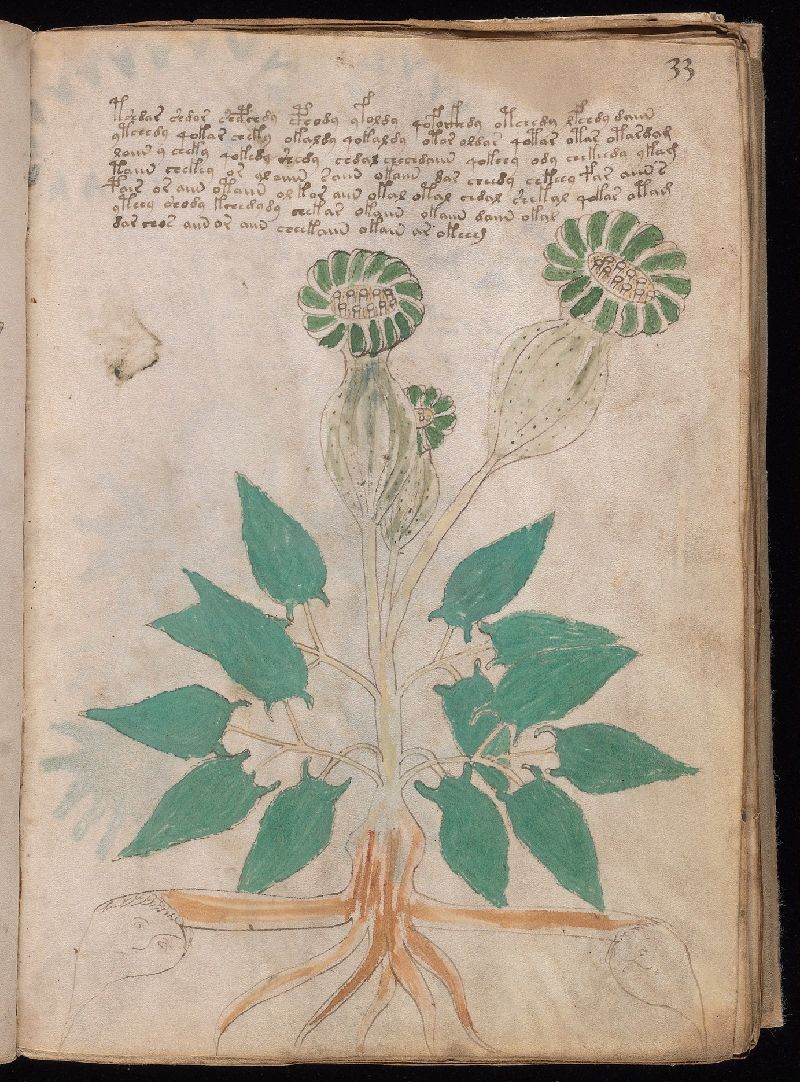
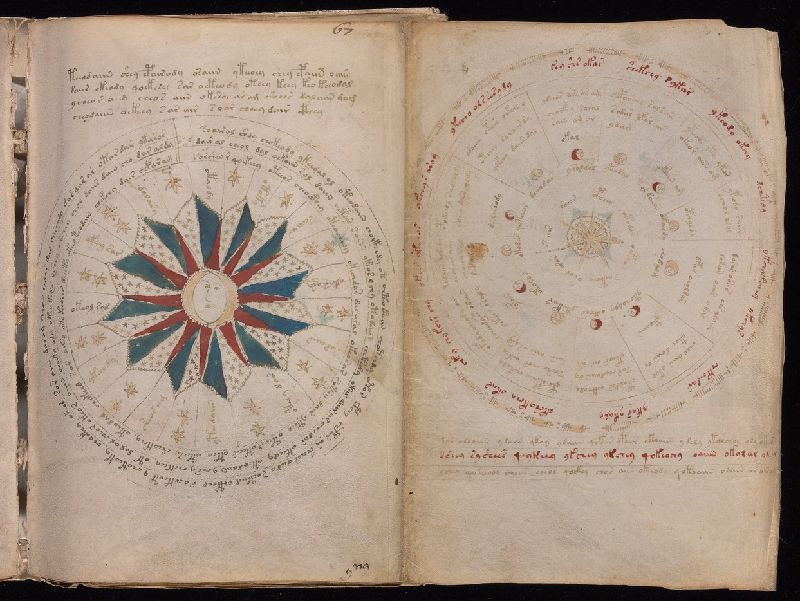
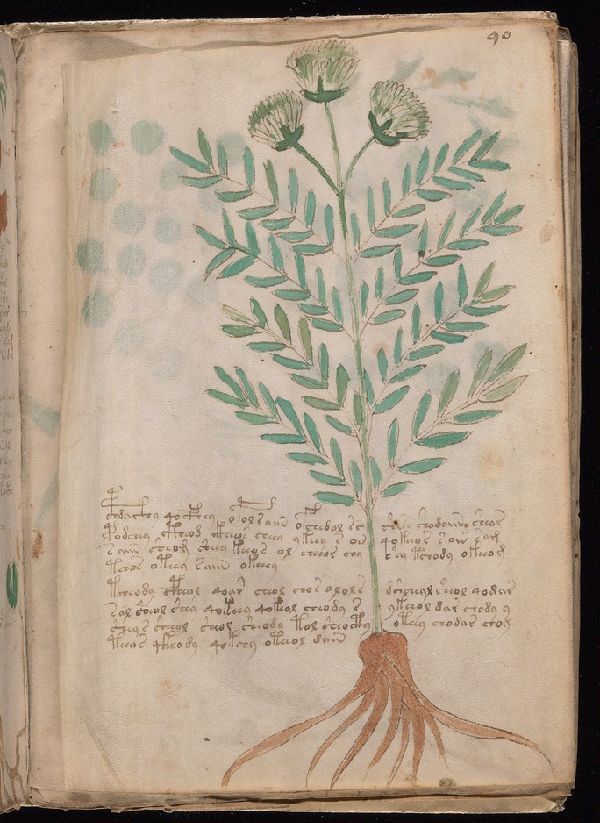
Sometime in the early 1400s, someone filled 240 pages of vellum with a script that has no parallel and a language no one has matched. Six centuries of scholars, cryptographers, and codebreakers have tried, and failed, to read it.
We cannot read it either. But we can measure it. Scroll down.
The plants do not grow anywhere on Earth. The star charts match no sky. The script repeats and flows like writing, yet every attempt to read it dissolves under inspection.
These are real pages from the manuscript, held at Yale's Beinecke Library. Look closely, and the writing almost makes sense. Almost.
The text is consistent, fluent, and patterned. That consistency is exactly what makes the manuscript so hard to dismiss as nonsense, and exactly what we can put numbers to.
Measure the word frequencies and they follow Zipf's law, the same lopsided curve every human language obeys. Measure the per-character entropy and it lands inside the range of real languages. By those tests, this is not random noise. But measure how rigidly the words are built, and the manuscript pulls away from every natural language we have checked.
Flat word frequencies, no repeating internal patterns, no Zipf curve. The Voynich text is clearly not this.
More organized than gibberish, yet more rigidly patterned than any natural language we measured. It looks language-like on Zipf and entropy, and anomalous on word-internal structure.
Zipf curve, language-range entropy, and a looser, more varied internal word structure than the Voynich shows.
That gap is the real puzzle. Not a hidden message waiting to be unlocked, but a structure that is too organized to be noise and too rigid to be an ordinary language.

Decades ago, Prescott Currier noticed the manuscript splits into two writing systems, which he called Language A and Language B. They use the same script but behave differently. With a reproducible structural measure, that split is not a hunch. It is statistical.
The earlier sections share a consistent statistical fingerprint in how words are built and combined.
The later sections separate cleanly from A on the same metric, a large, reliable effect, not noise.
Proto-Romance. A medieval health manual. An elaborate hoax. "AI cracked it." Dozens of announcements, across a century. Each one fits a few words, declares victory, and never produces coherent, repeatable text that holds up on pages the author never used.
We do not claim to read the Voynich Manuscript. We claim something narrower and verifiable: we can measure its structure, and what we measure is reproducible by anyone. Here is where to go next.
The measurements: Zipf, entropy, the intermediate regime, across dozens of corpora.
Explore → The methodThe reproducible pipeline behind every number on this page.
Read → The claimsNo. Every famous solution, and the test each one fails.
See → The two handsHow the manuscript splits into two statistically distinct writing systems.
Compare →A note on honesty: this page measures structure, it does not read the text. Nothing here is a decipherment or a translation. The value is in what can be checked: numbers any researcher can reproduce, and a puzzle stated plainly instead of solved by assertion.