Structural & Statistical Findings
What the text itself revealsThe Text Is Not Random
Information-theoretic analysis shows word co-occurrence patterns consistent with meaningful semantic structure. High-entropy words appear where they would in meaningful text — a pattern that is very difficult to replicate with random or hoax generation.
Source: Montemurro & Zanette (2013). Keywords and Co-Occurrence Patterns in the Voynich Manuscript. PLOS ONE, 8(6), e66344.
What it establishes: The text has semantic-like structure.
What it does not establish: What the structure encodes.
Two Distinct "Languages" Are Real (Currier A/B)
A Beta-Binomial mixture model applied to 11 character-pair substitution ratios, with no prior knowledge of Currier's labels, independently selects two groups and predicts held-out folio labels at 89.2% accuracy. The distinction is not a codicological artifact — it persists within individual quires. The A/B label is a low-resolution projection of a three-layer generative structure: a boolean folio switch, a template system, and an independent gradient d/l dimension.
Source: Parisel (2026). A Quantitative Confirmation of the Currier Language Distinction. arXiv:2604.25979.
What it establishes: The distinction is real and structural, not observational.
What it does not establish: What the two "languages" represent — two scribes, two registers, or something else.
The Text Follows Statistical Laws of Natural Language
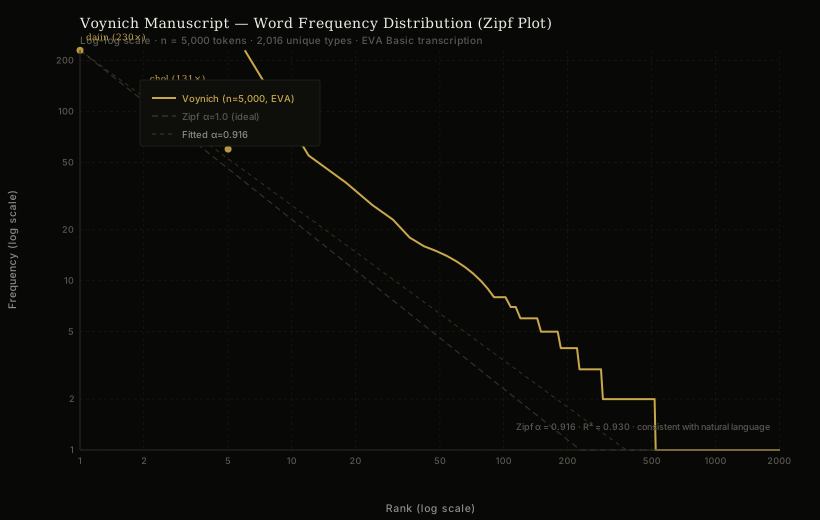
The Voynich text obeys Zipf's law, has entropy levels consistent with natural language, and shows type-token ratios within the range of known writing systems. These properties alone do not confirm it encodes a natural language, but they rule out simple random generation.
Source: Multiple analyses from Stolfi (1997+), Landini (2001), and subsequent researchers.
What it establishes: The text is statistically language-like.
What it does not establish: Which language, or whether it encodes one at all.
Historical & Provenance Findings
What documents and physical analysis revealMedieval European Origin, 1404–1438
Carbon-14 dating of four vellum samples places production between 1404 and 1438 (95% confidence interval). The ink and pigments are consistent with medieval European production. Modern forgery is definitively ruled out.
Source: University of Arizona radiocarbon dating (2009). Reported in multiple peer-reviewed venues.
Multiple Scribes Wrote the Manuscript
Paleographic analysis identifies at least five distinct scribal hands, labelled by Lisa Fagin Davis (2020). The hands correlate imperfectly but significantly with Currier A and B sections.
Source: Davis, L.F. (2020). Scribal hands in the Voynich Manuscript. Manuscript Studies.
Proposed Decipherment Hypotheses
What has been proposed — none confirmed14 Proposed Word Identifications
By comparing Voynich illustrations with labeled medieval manuscripts, Stephen Bax (2014) proposed identifications for 14 words, including the word for Taurus (the constellation). Methodologically sound comparative approach.
Source: Bax, S. (2014). A proposed partial decipherment of the Voynich script. Working paper ↗.
Status: Not independently replicated. Disputed but not refuted.
Proto-Romance Language Hypothesis
Gerard Cheshire (2019) proposed the manuscript was written in proto-Romance. Published in Romance Studies.
Source: Cheshire, G. (2019). Romance Studies. [RETRACTED]
Status: Paper retracted by the journal. Claim rejected by comparative linguists.
A Computational Perspective
One approach among manyNo Natural Language Matches the Full Structural Profile
BPE VMML analysis across 63 corpora from 35+ language families found no corpus simultaneously occupying the Voynich discriminant zone on all three metrics (VMML, Boundary Concentration, CBMI). Tagalog (Noli Me Tangere) is the closest match on VMML alone but fails on BC and shows cross-text instability.
Source: Silva (2026). Zenodo. DOI: 10.5281/zenodo.20668229 and 10.5281/zenodo.20668970
What it establishes: No tested natural language replicates the Voynich profile.
What it does not establish: What the Voynich is.
CBMI Is a Strong Independent Discriminant for Currier A vs B
Per-folio analysis using the Gaskell & Bowern (2022) canonical corpus (36,361 tokens) finds that Cross-Boundary Mutual Information (CBMI) — the mutual information between characters immediately flanking BPE morpheme boundaries — is the primary structural discriminant between Currier A and B folios. CBMIA = 1.97 bits vs CBMIB = 1.51 bits; Cohen's d = −1.01 (large effect); permutation p < 0.001 (n = 10,000 shuffles, Bonferroni-corrected). Crucially, the effect survives a within-quire control (pooled nA = 46, nB = 33; permutation p = 0.0008; Fisher combined p = 0.001), ruling out manuscript section as a confound. The CBMI signal is orthogonal to Parisel's (2026) vowel-selection model and is robust across all three metrics: BC, BPE-ratio, and CBMI all show A > B. Fisher combined full-corpus: χ²(6) = 40.66, p < 0.000002.
Source: Silva (2026). §5.9 — per-folio Currier A/B reanalysis. DOI: 10.5281/zenodo.20668229 (v2.3, 2026-06-08)
What it establishes: CBMI is a large-effect, permutation-validated discriminant between A and B folios that survives within-quire controls. A and B differ structurally at the morpheme-boundary level.
What it does not establish: Why they differ — two scribes, two linguistic registers, and two compositional phases all remain consistent with this result.
Tagalog's Elevated VMML Is Text-Specific
Full-corpus computation of El filibusterismo (Rizal, n=114,777 tokens, identical protocol) yields VMML=5.578 — below the alphabetic ceiling. Cross-text Δ=0.336 units. The supra-ceiling Tagalog value is not a general language property.
Source: Silva (2026). DOI: 10.5281/zenodo.20668970
