What People Claim It Is
These are theories seriously proposed and publicly circulated — some for decades — that have been examined and found incompatible with the physical, statistical, or historical evidence.
● Popular Theories · 8 entries · Tested and found lacking
"An Extraterrestrial Language"
Proposed by fringe theorists since the 1960s. No evidence of non-terrestrial origin has ever been identified. The vellum, ink, and pigments are entirely consistent with 15th-century European production. Carbon dating (2009, University of Arizona) places the vellum's production firmly in 1404–1438 — a range that fits standard medieval European manuscript production with no anomalies.
Carbon dating 2009 · UArizona · vellum 1404–1438"A Medieval Witchcraft or Alchemy Manual"
Popular in sensationalist media and documentary treatments. The manuscript predates most recognized witchcraft literature as a genre. No verified connection to any known esoteric tradition has been established. The illustrations — while unusual — do not match documented magical systems, grimoires, or alchemical iconography of the period when examined by specialists in those traditions.
Historical analysis · no esoteric tradition match"A Copy or Cipher of Another Known Book"
Proposed repeatedly — attributed to Roger Bacon's writings, various medieval herbals, and other known texts. No source text has been identified despite more than 100 years of active search by researchers with access to major manuscript collections. Structural analysis shows the text is not a simple substitution or transformation of any known language or document.
100+ years of search · no source identified"Pure Random Noise (a Meaningless Hoax)"
Schinner (2007) demonstrated that a Cardan grille mechanism could produce statistical properties similar to the Voynich text, supporting a hoax interpretation. However, Montemurro and Zanette (2013) found semantic clustering in the text — a pattern inconsistent with random generation. The statistical signature of meaning is present. Explaining how a hoaxer produced it without intending meaning remains unresolved and implausible.
Schinner 2007 · Montemurro & Zanette 2013 · semantic clustering confirmed"A Lost Natural Language from an Obscure Region"
Proposed for dozens of languages over the decades — Arabic, Hebrew, Latin, Welsh, Nahuatl, Cherokee, and many others. None has produced a verifiable translation confirmed by independent review. Partial pattern matches have been announced repeatedly, but none have survived systematic scrutiny or produced a decipherment that allows prediction of new text.
Dozens of candidates · zero confirmed translations"Glossolalia (Spiritual Babbling)"
Proposed by those struck by the manuscript's language-like appearance combined with its apparent unreadability. This explanation doesn't account for the consistent grammatical structure found across folios, the Zipf distribution of word frequencies (characteristic of natural language), and the semantic clustering identified by computational analysis. Random spiritual babbling does not produce these statistical regularities.
Zipf distribution · grammatical consistency · semantic clustering"A Personal Cipher for One Person's Private Notes"
Plausible on its face and not falsifiable without the key. However, the consistent cross-folio grammar and vocabulary distribution across sections covering what appear to be different subjects (herbal, astronomical, biological, pharmaceutical) suggests a system intended for communication — or at minimum for re-reading across time — rather than pure privacy. A personal cipher produced over years would show more drift.
Cross-folio grammar consistency · vocabulary distribution analysis"An Elaborate Renaissance Forgery"
Proposed as a money-making scheme attributed to Wilfrid Voynich himself, who acquired and named the manuscript in 1912. Carbon dating (2009) places the vellum's production in 1404–1438 — roughly 500 years before Voynich found it. The forgery hypothesis is definitively ruled out by physical evidence: no forger in 1912 could have fabricated 15th-century vellum that passes radiocarbon dating.
Carbon dating 2009 · 1404–1438 · forgery hypothesis eliminatedWhat the Evidence Eliminates
These are hypotheses that have been subjected to systematic quantitative testing. Elimination here means the hypothesis produces predictions inconsistent with the measured structural properties of the Voynich text.
● Scientific Eliminations & Open Questions · 18 entries · Last updated June 2026
Random or Gibberish Text
BPE structure survives character perturbation testing. When characters are randomly shuffled (n=50 trials, corpus-size matched), Voynich VMML drops 22% — a structured decay signature. Truly random text collapses by more than 60% under identical perturbation. The internal structure is real.
Paper 8 · permutation test · n=50Tagalog as base language
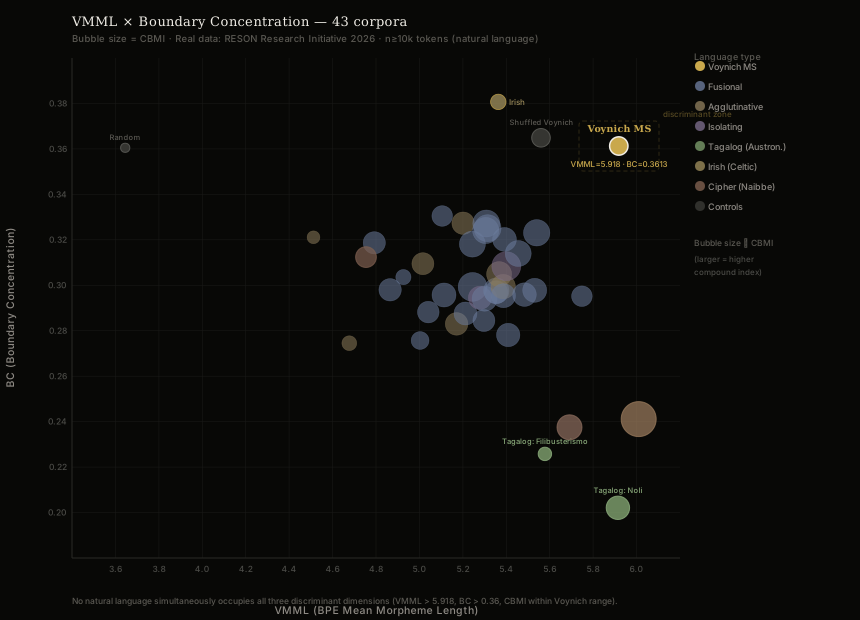
Critical three-metric mismatch. While Tagalog (Noli Me Tangere, full corpus) enters the Voynich 95% CI for VMML, Boundary Concentration decisively diverges: Tagalog BC ≈ 0.20 (infix-dominated) vs Voynich 0.361 (edge-concentrated). The structural mechanisms are incompatible.
Papers 7 & 8 · BC divergence = 0.161Tagalog VMML as a stable language property
El filibusterismo (full corpus, same author as Noli) yields VMML = 5.578 — below the Alphabetic Ceiling. Cross-text variation Δ = 0.336 units. Supra-ceiling VMML in Tagalog is text-specific, not a property of the language. The Noli result does not generalise.
Paper 8 · Rizal cross-text instabilityPhilippine languages broadly
Cebuano (NLLB corpus): VMML = 5.609, below the Alphabetic Ceiling. No Philippine language tested simultaneously matches Voynich on VMML + BC + CBMI. VMML elevation, where it appears, is language- and text-specific, not a family-level pattern.
Paper 8 · multi-language Austronesian analysisIndonesian and Malay
VMML values are well below the Alphabetic Ceiling: Indonesian 4.838, Malay 5.293. Both languages sit comfortably in the mid-range of natural language distribution. Neither approaches the Voynich zone on any of the three metrics.
Paper 7 · 55-corpus baselineBasque as high-VMML reference
Basque (Euskara) is a canonical agglutinative language used as a control. VMML = 4.475 on natural text corpus — significantly below the Alphabetic Ceiling despite canonical agglutinative morphology. Confirms that agglutination alone does not produce high VMML; morphological architecture matters more than typological label.
Paper 7 · agglutinative controlSchinner's stochastic hoax model (2007)
Schinner proposed the Voynich Manuscript was generated by a stochastic process simulating language without encoding real content. Random EVA generation under Schinner's model fails to replicate the full 3-metric profile — particularly the BC + CBMI combination that accompanies Voynich's VMML.
Paper 7 · structural profile falsificationTimm's self-citation mechanism (2020)
Timm and Schindler proposed a word-stress positional model involving self-citation of previous tokens. The EBNF/MI trade-off irreconcilable with observed BPE structure: self-citation would produce distinct boundary concentration patterns inconsistent with Voynich's measured BC = 0.361.
Paper 7 · mechanism incompatibilityAny of 63 tested natural language profiles
The Voynich Discriminant Zone — defined by VMML + BC + CBMI simultaneously — is occupied by no natural language corpus from any of the 35+ families tested. Not because we stopped looking: we tested 63 corpora and none qualifies. The zone is empirically empty.
Papers 7 & 8 · full 63-corpus baselineIlocano as candidate language
Ilocano VMML = 5.785 provisionally exceeds the Alphabetic Ceiling, making it the only language besides Tagalog (Noli) to do so. However, BC = 0.248 — infix-dominated, incompatible with Voynich's 0.361. Additionally, n = 12,807 tokens sits near the stability threshold; result requires larger corpus confirmation.
Paper 8 · provisional · n near stability limitCebuano (formal literary register)
The NLLB Cebuano corpus contains substantial code-switching with English and Filipino, artificially suppressing VMML. Formal literary Cebuano — comparable to Rizal's novels for Tagalog — has not yet been tested. Result could move in either direction.
Corpus gap · register bias identifiedKapampangan, Hiligaynon, Malagasy
Untested Philippine-branch languages with complex focus-morphology (Kapampangan, Hiligaynon) and a remotely-derived Austronesian outlier (Malagasy). These would either confirm or refute the emerging hypothesis that VMML elevation tracks focus-morphology density rather than phylogenetic membership.
Untested · next phaseKapampangan
Untested. Philippine-branch language with exceptionally complex focus-morphology. VMML unknown. High priority given the Tagalog and Ilocano results — Kapampangan's morphological architecture may test whether supra-ceiling VMML is tied to a specific focus-system subtype rather than the broader Philippine voice system.
Corpus acquisition pending · high priorityHiligaynon (Ilonggo)
Untested. Approximately 9.3 million speakers. Philippine voice system with morphological architecture distinct from Tagalog and Cebuano. A result either above or below the Alphabetic Ceiling would directly test the focus-morphology density gradient hypothesis — whether VMML elevation is a structural gradient or a discrete threshold.
Corpus acquisition pendingMalagasy
Untested. Austronesian but geographically isolated — the language reached Madagascar via maritime migration, diverging from other Austronesian branches for over a millennium. VOS word order and distinct morphological system. A result here would test whether the pattern emerging from Philippine-branch languages is Philippine-specific or a broader Austronesian property.
Corpus acquisition pending · geographical outlier testFormal literary Cebuano
The NLLB Cebuano corpus (social media, code-switching with English and Filipino) yields VMML = 5.609 — below the Alphabetic Ceiling. This is plausibly a register artifact. Formal literary Cebuano equivalent to the Rizal corpus used for Tagalog has not yet been tested. The result could move in either direction and is needed before Cebuano can be definitively characterized.
Register gap identified · literary corpus neededVoynichese as classical cipher of Latin or Greek
If the Voynich text were a substitution cipher of Latin or Greek, BPE segmentation would recover the morphological density of the underlying language, placing VMML within the alphabetic zone (≤ 5.748 — the Alphabetic Ceiling derived from 55+ corpora). Voynich VMML = 5.918 is inconsistent with any tested alphabetic natural language. A monoalphabetic substitution cipher cannot produce this structural elevation.
Paper 7 · 55+ corpora · alphabetic ceiling falsificationFinnish or Uralic languages as structural analogue
Finnish (Wikipedia corpus) VMML ≈ 4.6–4.9 in preliminary tests — well below the Alphabetic Ceiling despite canonical agglutinative morphology. The high-VMML pattern is not explained by agglutination generally. Finnish's morphological complexity produces a distinct structural signature that does not approach the Voynich zone on any of the three discriminant metrics.
Preliminary · agglutination ≠ VMML elevation confirmedThe Discriminant Space
VMML × Boundary Concentration × CBMI — 43 corpora. No natural language occupies the Voynich position simultaneously across all three dimensions.